You’ve probably been there: you wake up from a weird, vivid dream and wonder where it came from, or what it’s trying to tell you. Is there a deeper meaning to it?
Sadhguru flips this completely. We’re asking the wrong question. Rather than parsing dreams for meaning, we need to start by examining why we dream in the first place. His insights challenge the conventional understanding of the sleeping mind.
Dreams, Sadhguru suggests, are less about prophecy than process – a nightly release for our desires and accumulated memories that we know as Karma.

Sadhguru: There are different aspects of your mind and existence that we refer to as dreams. You have, of course, heard of the famous speech, “I have a dream.” But right now, we are mostly talking about dreams that you do not actively create – they seem to come to you from somewhere. These dreams can be divided into four main categories.

More than 90 percent of dreams are just a release. When I say release, you need to understand that most human minds cannot help but desire whatever they recognize as good, beautiful, attractive, or valuable. Most of the desires that the mind generates throughout the day are not even conscious. They are simply happening because the mind is in that mode of desiring many things. It is your fortune that not all your desires come true. If they did, you would be in a great mess.
These kinds of dreams are an exaggeration of all the things you desire. Or in other words, it is a release. If this release does not happen in your dream, the desire could turn into great frustration and compulsion. In that sense, the dream is working for you.
You can release these desires at night when you are fast asleep because the body is at rest, so there is a lot of energy available for the activity of the mind. The mind uses this time and energy to work itself out. Ninety percent of dreams fall under this category. There is nothing to do about this, nothing to remember, no need to remember – let it go.
But if you have a lot of dreams on a daily basis, you must look at your day. You must become more conscious. The more conscious you become during your day, the fewer dreams you will have at night. The more unconsciously you aspire for things around you, the more dreaming will happen. If you meditate strongly enough through the day, there will be considerably less dreaming at night.

Another manifestation of dreams is based on something called prarabdha.
There is a vast accumulation of memory in the human system, which we refer to as Karmic structure or Karmic body, which is essentially memory. If all your Karmic memory came into play in your life right now, your mind would break. It is too much for anyone to handle.
This happened to me over forty years ago. Suddenly, I had a huge experience [Sadhguru’s enlightenment], and lifetimes of memory rushed through my mind. Because of the immense experience, I was able to handle it. Otherwise, the mind would break when latent memory becomes an active process.
Nature, or your system, has evolved a way of accessing only the allotted memory to be dealt with right now. This is called prarabdha. It was a very common term in our grandmothers’ time. If something was not happening the way they thought it should happen, they would say, “Ayyo, prarabdha” – meaning allotted memory is playing out.
So, the second type of dream is prarabdha playing out. It plays out in your day-to-day behavior, your thoughts, your emotions, and how your body feels. If you observe your body carefully, you will see that every day, it feels different – because prarabdha creates everything that happens.
Every memory release that happens in the mental structure creates a sensory pattern in the physiological structure. The type of prarabdha that is playing out determines how your body feels. If you are conscious and observe your body, you will know what is coming that day.
Many of you might have noticed that on certain days when some acute issue occurred, you were already feeling funny in the morning and then ended up crashing somewhere. You need not be enlightened or super-conscious to notice this. But, because people do not know how to decipher this, they walk into the issue. Those who know how to read it will step back on such days, because the Karmic memory or prarabdha influences not only how your body, mind, and energies function, but also what happens around you.
This is prarabdha finding expression, and the same happens at night in the form of dreams. These dreams may have all kinds of strange things mixed up – people who are around you and others you do not know; familiar and unfamiliar situations; all overlapping. You might remember dreams like these: you are in your home but some strange character is present. Or you are in a strange place but your whole family is there.
What is known to you and what is unknown to you, what you consciously remember and what you do not consciously remember – all that gets entwined in the dream. This is a release of prarabdha, and it could have some meaning.
You do not have to observe the images of the dream; you have to observe the residue of the dream. Is it just your latent desires being worked out, or did some other memory play a role in making it happen? Do not look at the imagery. Imagery is not important, but the residue it leaves on the body is. When you wake up in the morning, how do you feel?
This is the reason why those who are closely watching their life avoid all intoxicants and stimulants. Intoxicants and stimulants make your nervous system signal something completely different, so you cannot notice anything.
This second type of dream, based on prarabdha, could indicate many things if you are able to observe it carefully. It is good to watch prarabdha, especially if something concerns your health or the possibility of destruction or damage to your body.
I never talk about dreams because there are many people whose imagination will run wild on a daily basis: “I saw this in my dreams, so this is going to happen today; tomorrow that is going to happen.” Dreams will happen not only at night but throughout the day.
The third type of dream occurs when you touch certain states of experience in your life. Many of you might have noticed that after you went through a powerful experience – let us say you were initiated into Shambhavi, or you went through a Bhava Spandana or Samyama program,[1] or another initiation process – the pattern, type, and volume of your dreams could have changed.
A powerful experience means you have crossed some threshold within yourself. There are layers and layers of boundaries that you have set up within yourself. When you cross one layer, the dream pattern can shift significantly. The previously inactive memory bank could come into play. Suddenly, there is a new “can of worms” to deal with.
This happens when a powerful experience breaks through a certain barrier and brings about a new release of memory. These barriers are for your protection. If all of them opened up at once, your mind would break.
This warehouse of memory or Karmic substance is called sanchita. When a portion of sanchita enters your life, this life expands to a larger scope than before. Previously, your life was playing out within a certain volume of memory, but after you break through with a big experience, your life expands its scope.
If you handle it efficiently, a larger scope is a great thing. If you handle it inefficiently, it becomes troublesome. That is what human beings are struggling with: human life has a larger scope than that of other creatures. If you were like any other creature, you could eat and sleep and be fine. Because your life has a larger scope, you are suffering.
Similarly, when a larger scope of memory opens up, if you handle it right, it will be very wonderful; if you do not, it will be painful. But even if it is painful, in the ultimate scheme of things, it is still good for you. Yoga is painful, but we still do it because, in the larger scheme of things, it is good for us.
Opening up new areas of memory within you can be very painful because you are putting your life on fast-forward. What should have been handled in the next “edition” [lifetime], you are trying to handle in this edition because you are in a rush. You do not want to have one more edition.
This becomes more complex, but if you handle it right, it is very good. Otherwise, after entering the spiritual path, it feels like everything in the universe is kicking you from every direction. That is how it is when you open up a dimension that you did not handle before.
If you remain at the same step, life seems comfortable, but you will suffer stagnation. If you go to the next step, you are moving forward, but you will face much larger challenges.
In terms of dreams, this happens in a completely different way. Once sanchita begins to find expression in your dreams, you will have absolutely wild, meaningless dreams.
[1] Advanced meditation programs designed by Sadhguru
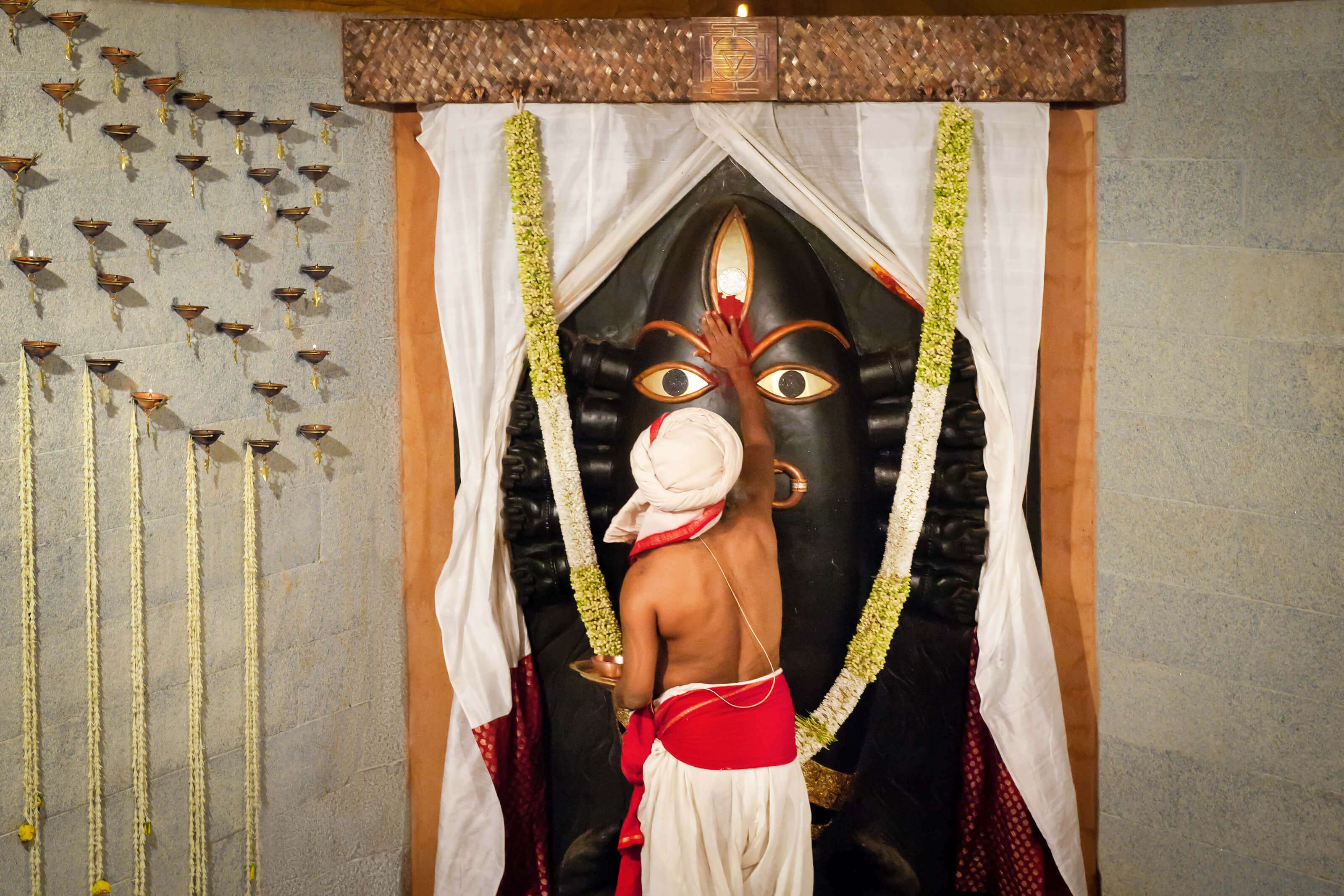
There is another kind of dream, which is not a dream in the usual sense. Now, for example, we have Linga Bhairavi.[2] She is a dream. We dreamed her up. You dream something up in such a way that it becomes reality – this is a dream to establish your consciousness and energy in a certain way.
In Australia, the Aboriginal people call the time of creation “Dreamtime.” The Creator dreamed it up. In India, we call this maya or illusion – an illusion can be called a dream. Or we call it leela, a play. The Creator is weaving his maya and playing around.
The words leela and maya describe creation most appropriately. And the whole science of what we refer to as tantra is about dreaming up something and slowly bringing it into reality. First you create it in your mind, then slowly roll it out, and eventually it becomes a reality.
All deities were made this way. Someone created them in their mind for a particular purpose, then rolled them out, and now they are as real as anything in everyone’s experience, not just their own. When your dream becomes a living experience for everyone, it is reality. Not because you are trying to influence or hypnotize them through powerful suggestion. They need not know anything.
When you walk into the Devi temple, it hits you in the face. You do not have to believe anything because she is reality. But years ago, she was just a dream. This dream is now a manifest reality. All of us happened as a dream that found physical expression. But you can also give expression to a dream without using material. This is not a dream in the usual sense – this is creation. This is how the entire creation happens.
You can play with the illusion. Suppose I want to play with a ball. There is no ball initially, but I start playing as if there were one. If I do this with sufficient intensity, after some time, there will be a ball that anyone who comes can feel.
This is creation, and it is also rooted in your dream because when you cross the boundaries of sanchita, you are touching the dimension of the source of creation. Usually, when you touch this, the mind will be overwhelmed unless it has been trained in a certain way. This is what some people describe as no-mind.
The moment you come in the presence of an energy that is beyond your understanding, your mind will freeze. This is not confusion – this is a state where the mind does not exist unless it has gone through a certain level of preparation.
When, as they would say in traditional terms, “you face God,” your mind freezes. What a waste. You did so much to get there, and when you do, you freeze. It is still useful. But if you have a mind that is sufficiently trained and there is substantial sadhana behind you, when you cross the place where there is no memory, you can still navigate yourself consciously.
Right now, your mind works the way it does only because there is memory. When you cross the boundary where memory ends and only perception remains, nearly all minds will freeze.
What you are doing through Yoga is training the mind to a place where if the memory or Karmic structure falls away, you still have a mind. Then, if your body drops – that is, if you die – you still have a mind. Now you can navigate yourself where you want to go. Otherwise, you go by your tendencies.
***
These are four types of dreams. The last one cannot really be called a dream – it is the other bank of existence. So, whatever the dream, learn to ignore it. If you start looking for meanings in dreams, you will become hallucinatory and lose meaning for your life.
[2] An exuberant expression of the divine feminine