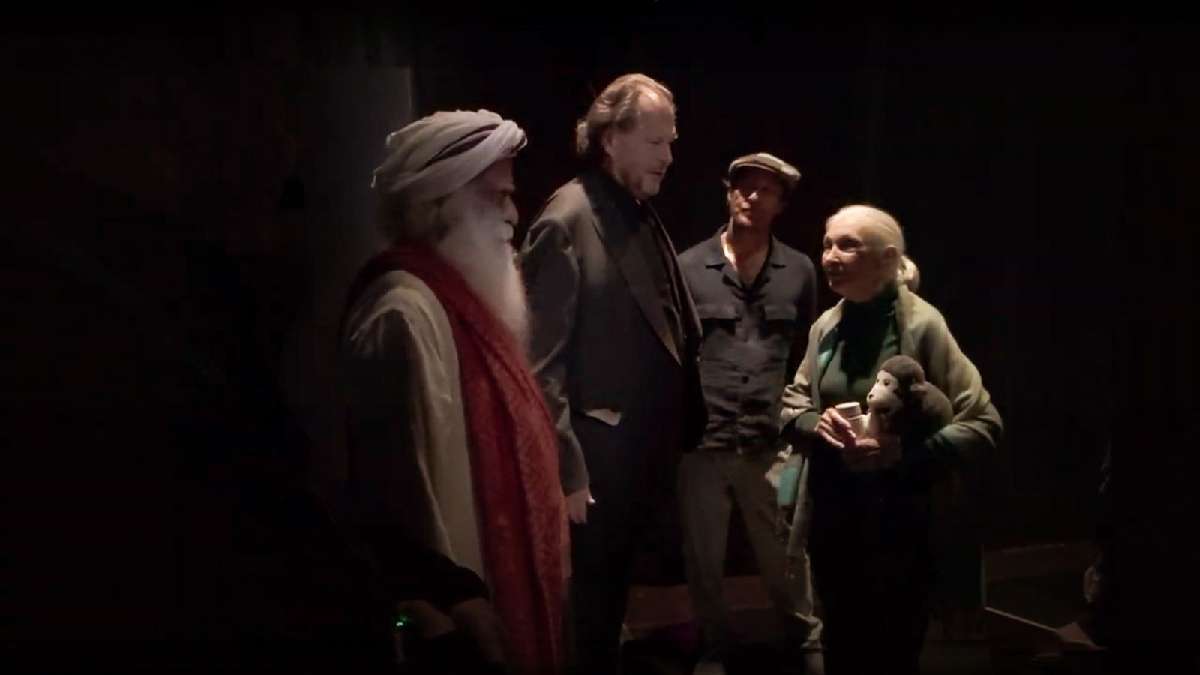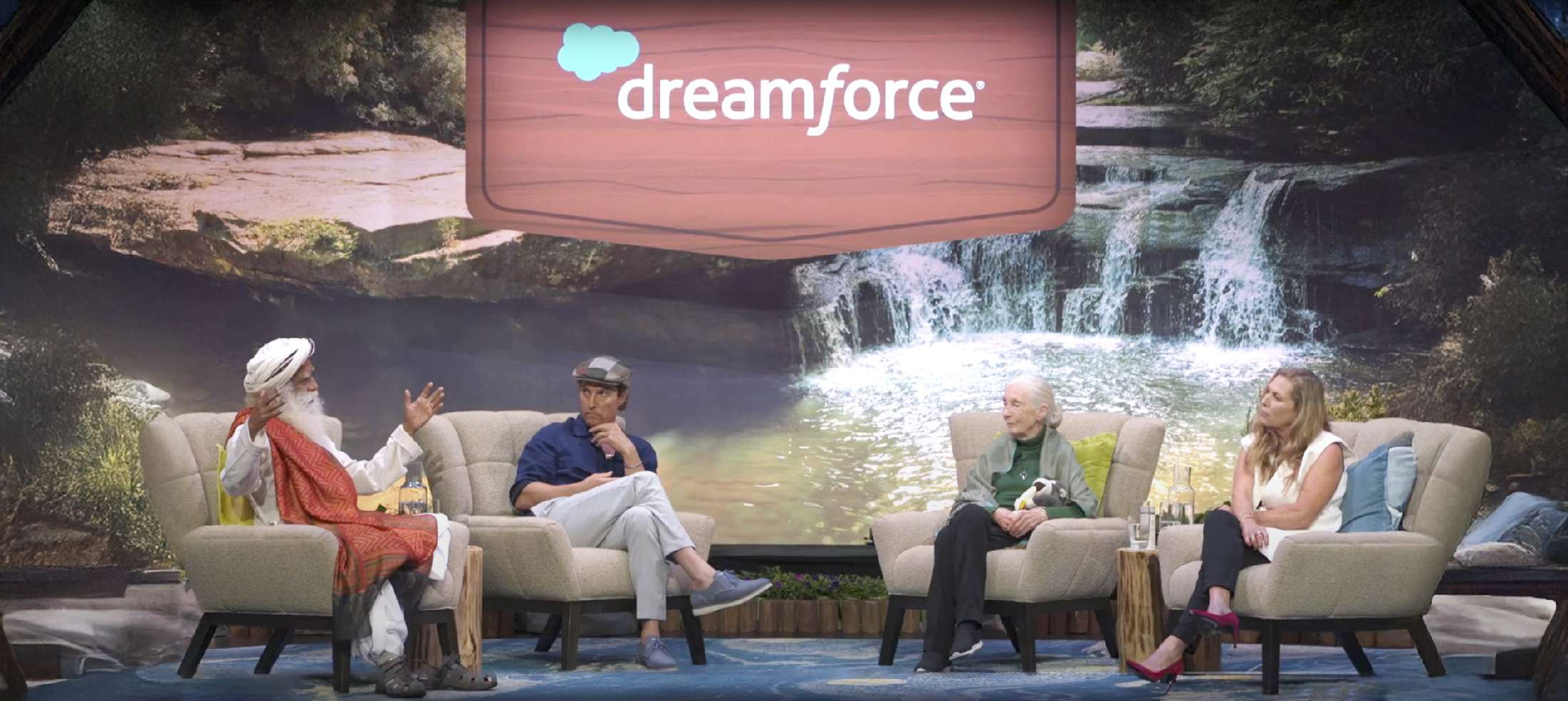
At Dreamforce 2024, the seemingly unlikely trio of Academy Award winner Matthew McConaughey, conservation icon Dr. Jane Goodall DBE, and Sadhguru came together on stage. What could these three possibly share? Turns out, it’s a vision for transformative change and a commitment to making a lasting impact.
At Salesforce’s premier AI event, they shared insights on how technology, environmental action, and empowered youth can shape a brighter future. Here’s an excerpt from their conversation.
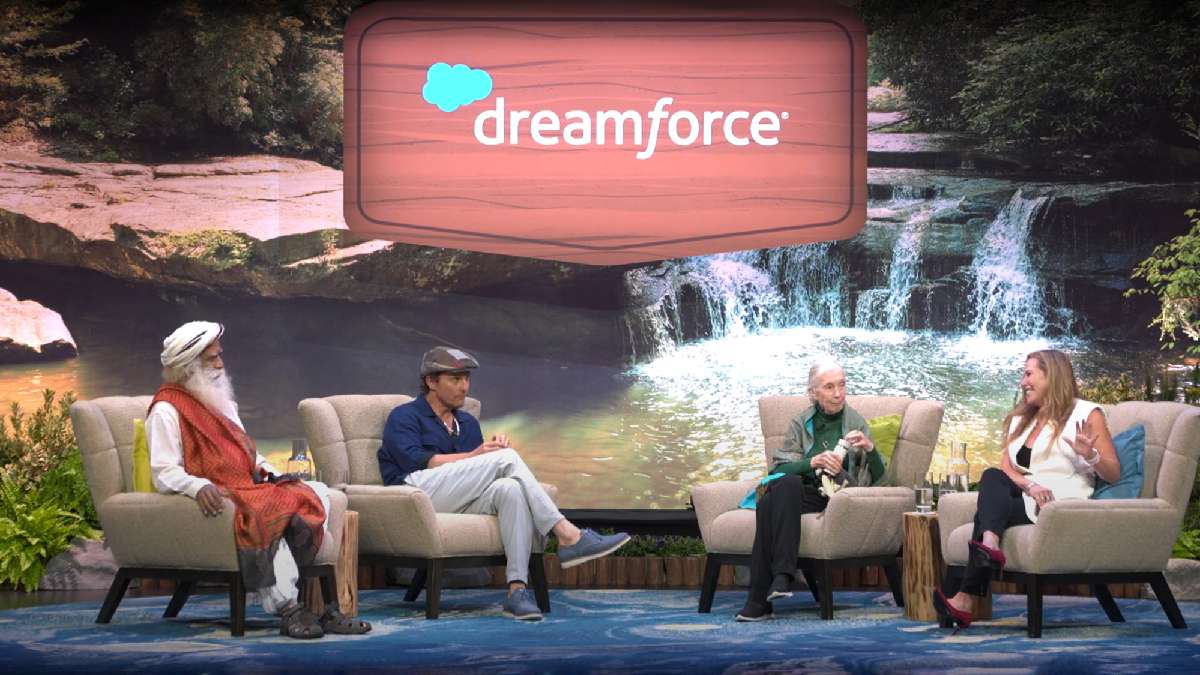
Moderator: When I first got this assignment to moderate this panel, I thought, “What do a primatologist, an award-winning Hollywood actor, and a renowned Guru have in common?” It turns out, a lot!
All of them are best-selling authors. All of them have been in major motion pictures. All of them are on the road for at least eight months of the year with their work. It’s going to be a fun dialogue.
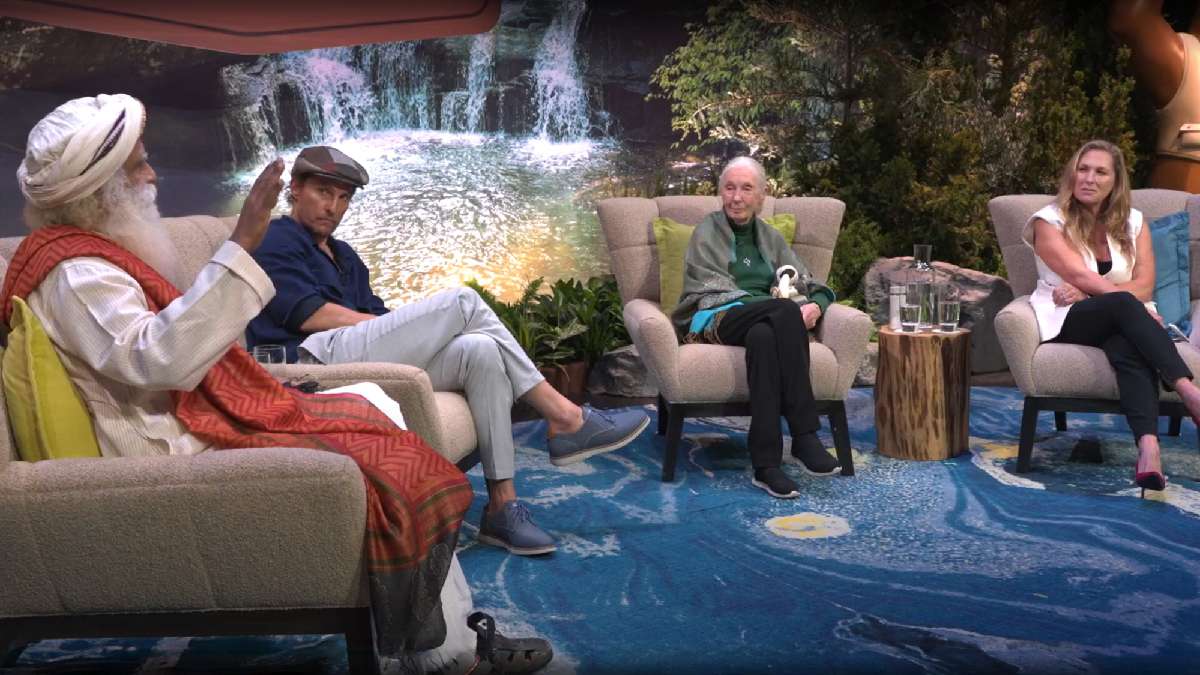
Moderator: The title of this session is “Leading with Purpose.” I’d like to know from all of you, what does that mean to you to lead from purpose?
Dr. Jane Goodall: Well, quite honestly, if you didn’t have purpose, I don’t believe you could lead.
Moderator: Agree!
Matthew McConaughey: Yeah, true!
A common denominator of whatever we define happiness as, is having a reason to get out of bed in the morning. When we have purpose, something that we’re building, we can feel it grow, keep moving forward in the big picture through our lifetime, and then hopefully leave something behind for the people that follow us.
Sadhguru: The purpose of every life is to find its fulfillment. It is not about every one of us coming up with our own purpose but seeing how to choose an action which will fulfill the purpose that every life is aspiring for. So you don’t lead with purpose. Once you identify the course of action, the purpose leads you.
Moderator: That’s beautiful.
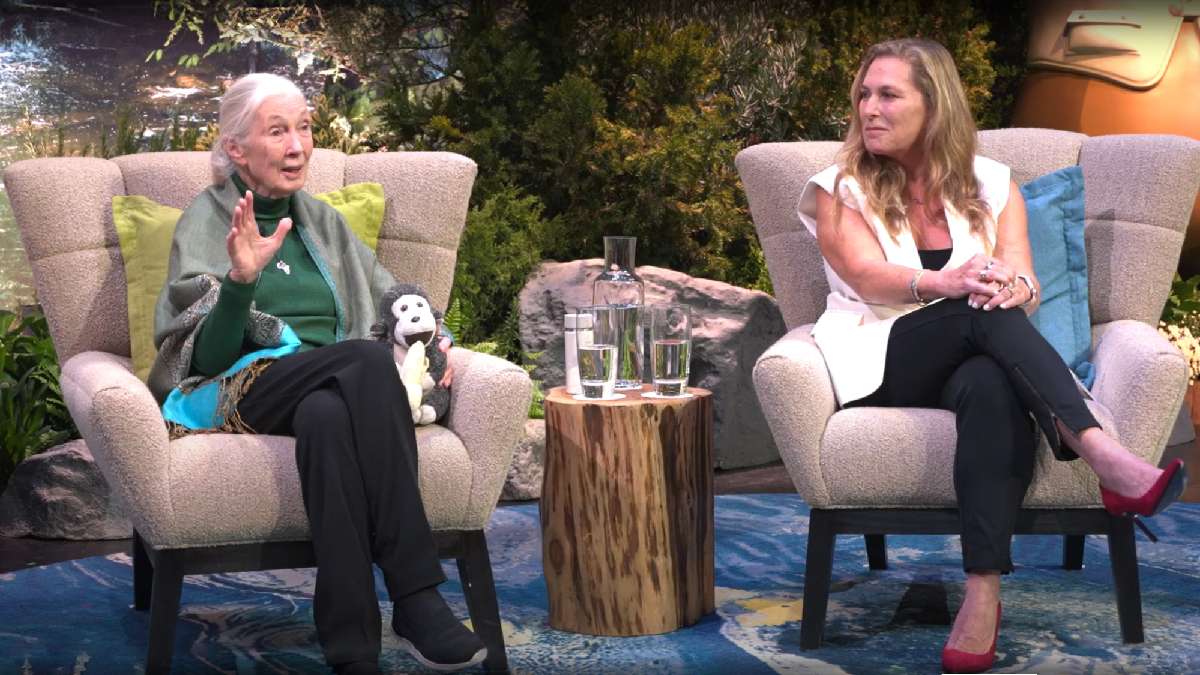
Dr. Jane Goodall: I began as a very young girl wanting to go to Africa, live with wild animals, and write books about them. Everybody laughed at me. I was told girls couldn’t do that sort of thing.
Anyway, as many of you know, I did get to Africa. I did get the opportunity to live with and learn from not just any animal, but the one most like us: the chimpanzee. And I spent so many amazing years learning about our closest living relatives.
I hadn’t been to college because we couldn’t afford it, but my mentor said I had to get a degree. I had to go for a PhD. And he got me a place in Cambridge University. Imagine how I felt when I was told, “They’re just animals. You can’t talk about them having personalities, minds, and emotions. Those are unique to humans.” That’s what was taught by science then.
Chimpanzees are so like us because they kiss, embrace, hold hands; males compete for dominance. They have a dark, aggressive, brutal side. But like us, they have a gentle side: love, compassion, and true altruism. Gradually, science has changed because of the chimps. Now we know that trees can communicate.
Visiting field study sites, I learned about the plight of the people living in and around chimpanzee habitat: crippling poverty, lack of good health and education facilities, farmland overused and infertile. And so we began a very holistic program, TACARE.
In wild areas, people living in poverty are destroying their environment. But in urban areas, people are buying the cheapest junk food because that’s all they can afford, and that food is almost always harming the environment – that’s why it’s cheap.
We realized if young people are not understanding the need for protecting the environment, we might as well give up. Then we began our program, “Roots and Shoots,” which is bottom-up. Young people get together and choose projects to make the world better for people, for animals, for the environment.
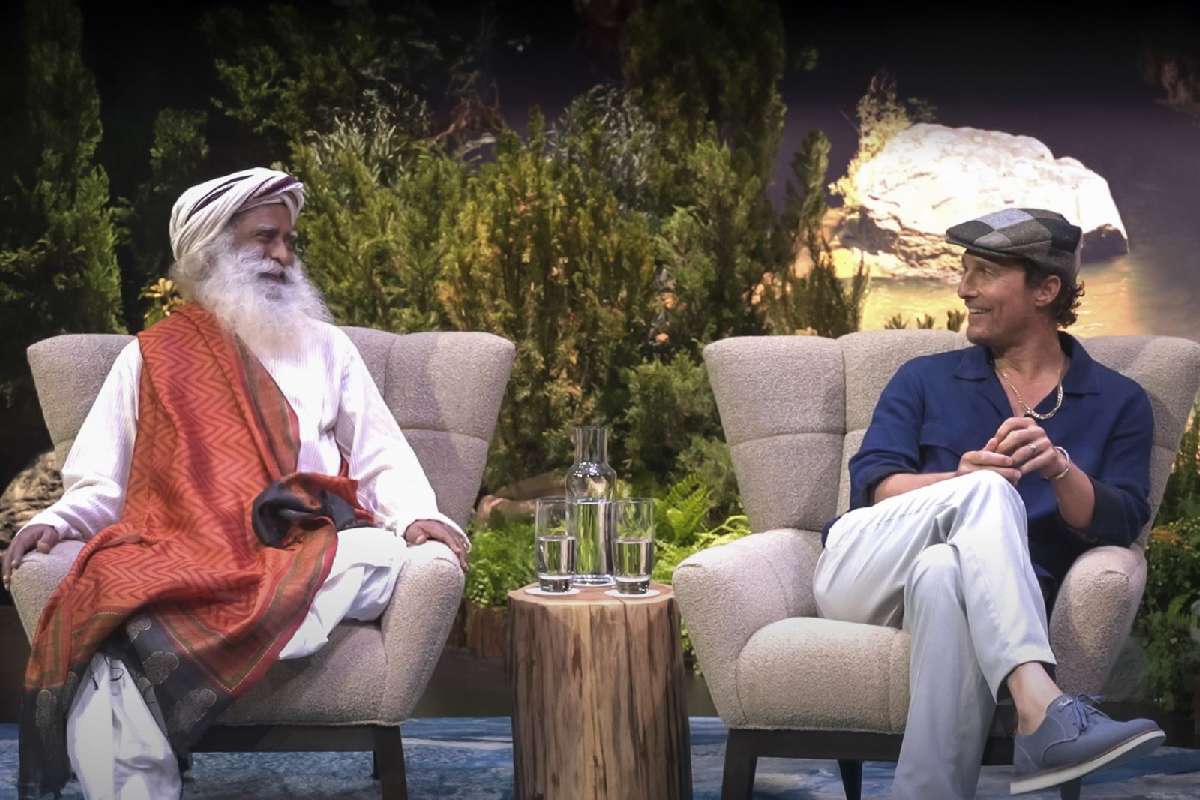
Matthew McConaughey: If younger generations are thinking differently, and understanding differently between their head and their heart, that will change how we live.
Camilla and I started the Just Keep Livin’ Foundation to be a curriculum in Title I schools in the United States. There are 50 percent dropout rates and food stamps, and we started a program where these kids can go after school. There are also nutrition goals.
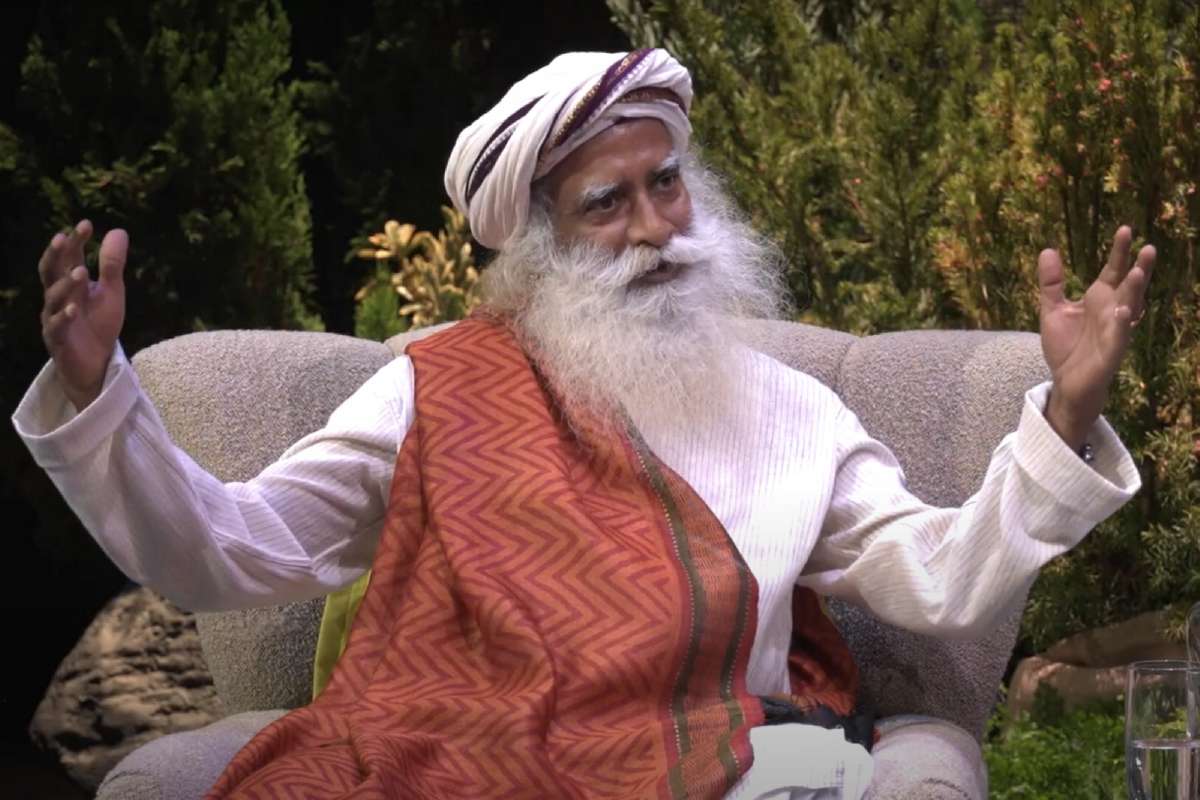
Sadhguru: The fundamental concern is the human being. If human beings attune themselves well, they are the greatest solution. If they are not attuned properly, they are the greatest problem, not just for their own lives but for every other life.
Every other life on this planet is suffering because of us. This is not an environmental lesson – this is a spiritual process. What we refer to as spiritual process is that you transcend the limitations of your physical experience and identity. If this doesn’t happen, we will create bigger and bigger problems because our intelligence functions according to our identifications and experiences.
We know from our experience that if we do not transact in terms of respiration, we won’t exist here for more than two minutes. In 1998, some UN agencies made a prediction that by 2025, 60 percent of southern India would face desertification.
Predictions don’t take into consideration what is beating in the human heart. So we started Project GreenHands. The average green cover in this state was 16 percent, but the national aspiration was 33 percent. I made a barefoot calculation that if we plant 114 million trees in this state, we will have 33 percent.
All of us consume, but all of us are not willing to do the compensatory activity. I made people sit under a tree and breathe. They clearly saw, “What I exhale, the tree inhales. What the tree exhales, I inhale.” Once they experience this, you can’t stop them from planting trees. Last week, we completed [the goal of] 114 million living trees in that region.
We took up one river [with Cauvery Calling], which has a river basin area of 83,000 square kilometers. It takes 2.42 billion trees to make the river flow once again.
Life on this planet is sustained by a tremendous phenomenon called photosynthesis. Compared to what it was 1000 years ago, today only 15 percent of the green cover is left. That means only 15 percent of the photosynthesis is on.
Every extra green leaf that you put on this planet from this moment onwards is one small step towards climate mitigation.
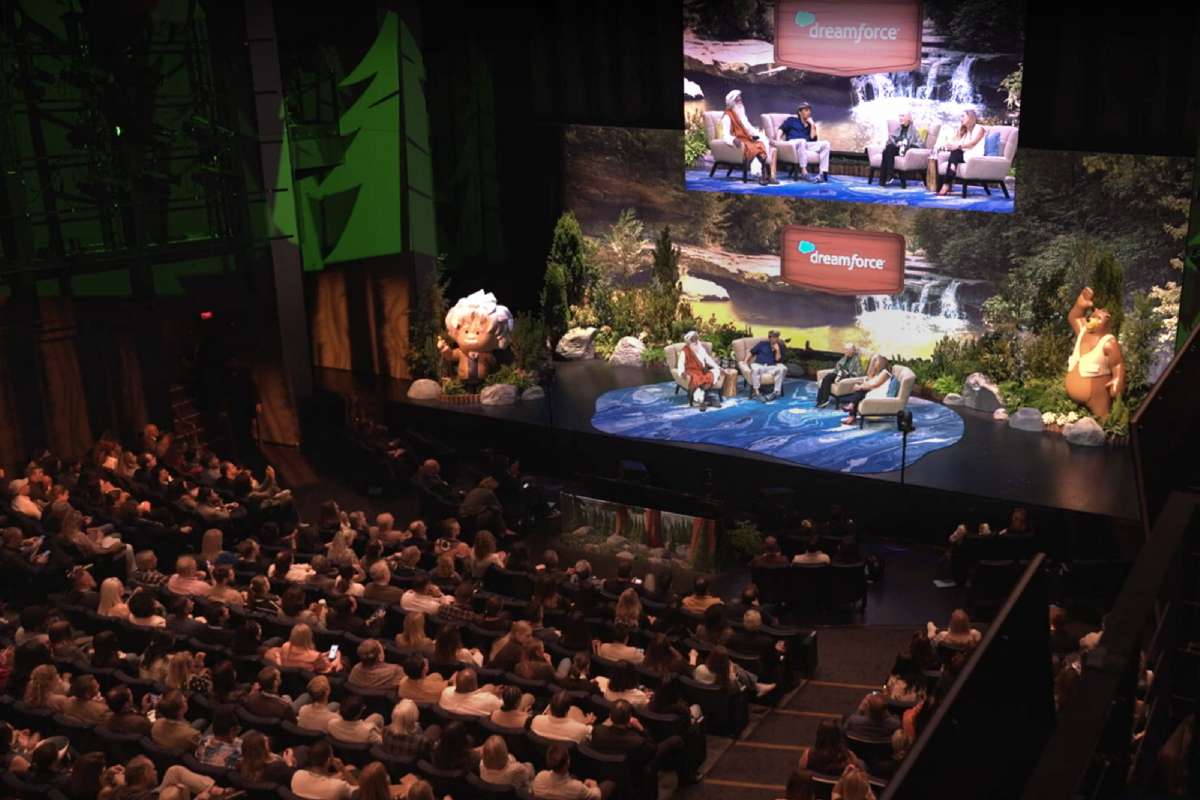
Moderator: Here we are at the biggest AI conference in the country. And I wonder how you’re thinking about AI in your own work, and how you think that humans and machines can live together in the world. A little bit about what you’re worried about it, and what we can be hopeful about.
Dr. Jane Goodall: I can think of many, many ways AI can make the world a better place. My worries, though, are if it gets in the wrong hands. That’s the scare. AI, like everything else, is a tool, and the tool can be used in different ways. When it’s in good hands, then it’s fantastic. But it’s not always in good hands. Can AI answer how we keep it out of bad hands?
Sadhguru: Artificial Intelligence is a tremendous empowerment. We are on that threshold where human beings could launch themselves to become superhuman beings. To be super with anything is only good when our intent and identities are inclusive. Between nations, organizations, political parties, when we don’t trust each other, inevitably, there will be lots of upheavals. But you cannot stop technology.
At the pace at which this particular technology will go, the transition time for people to catch up is so little, so there will be pretty serious collateral damage, but we must minimize it with some compassionate heart and an inclusive approach towards everything. Anything we think has to be universal. Otherwise, we will be a very destructive force.
Matthew McConaughey: AI is going to have consequences both ways. There’s no way to keep it out of the tyrants’ hands and the bad guys’ hands. I just hope it’s in more good hands.
But overall, I am excited and optimistic. We’ve had big changes in society throughout time. Let’s see what we create, because we are creating a vision of ourselves.
Sadhguru: One of the most beautiful things the evolutionary process has produced is the human mind. But today, human mind is the basis of most of the misery that human beings go through.
AI is going to be a super expansion of our own mind. We need to watch this carefully. You can call this stress, tension, anxiety, depression, whatever, but essentially, our own intelligence is poking us. What is a miracle has become misery. So once again, it’s important that human beings learn how to make a miracle out of this.
As these transformative technologies are unfolding, it is extremely important that we focus on individual human transformation. If we don’t do that, what we create will turn against us, not because technology is bad – simply because we don’t know how to handle it.
Moderator: Yeah, I agree. We heard AI is a tool, a mirror, and an extension of us. I have a lot of hope that it will be beautiful. And we have to walk into it with intention, inclusion, and universality. Thank you so much.