

Lunar Hindu New Year
Receive Devi's Grace on this Special Occasion
19 & 20 March; 13, 14 & 15 April 2026
LINGA BHAIRAVI COIMBATORE
The Lunar Hindu New Year is very significant, not just culturally, but scientifically too, because it takes into account the relationship between our planet, the sun and the moon, and its impact on the human system.
In India, each region has a unique way of celebrating the Lunar Hindu New Year. Although the celebration is known by different names in different regions of India, essentially, it marks the beginning of the new agricultural season – the basis of life in these cultures.
Upcoming Festivals
19 March
Navreh – Kashmiri New Year
Nyepi – Balinese New Year, Bali, Indonesia
Ugadi – Telugu New Year
Gudi Padwa – Marathi New Year
Chaitra Sukhladi – New Year observed in many states in northern India (Chaitra Navratri: 19 Mar to 27 Mar 2026)
Cheti Chand – New Year for Sindhis in Gujarat
20 March
Cheti Chand – New Year for Sindhis in Rajasthan
Sajibu Cheiraoba – New Year in Manipur (Sajibu Nongma Panba)
Nowruz – Persian New Year
13 April
Bizhu or Bizu – New Year in Mizoram and parts of Arunachal Pradesh, Tripura, and Assam (Chakma people; observed on 13 Apr and 14 Apr)
14 April
Baisakhi – New Year in Haryana, Punjab, Jammu and Kashmir (Mesha Sankranti)
Buisu – New Year in Tripura (also known as Boisu or Bwisu)
Puthandu – Tamil New Year
Bohag Bihu – Assamese New Year (Rongali Bihu; 14 Apr to 16 Apr 2026)
Jur Sital – New Year in Bihar and Jharkhand (Maithil New Year)
Sangken – New Year in Arunachal Pradesh and parts of Assam (14 Apr to 16 Apr)
Nepal Sambat – New Year in Nepal (Nepala Sambata)
15 April
Vishu – Malayalam New Year
Pana Sankranti – New Year in Odisha (Maha Bishuba Sankranti)
Bisu Parba – New Year of Tulu Nadu in Karnataka and Kerala
Bwisagu – New Year in Bodoland, Assam
Pohela Boishakh – Bengali New Year (Naba Barsha or Poila)
“New Year in the lunar calendar marks the renewed cycle of life. To propel life with new energy and vitality comes easy in an offering mode. The period post spring equinox is ideal to align with Devi and her grace.” —Sadhguru
As part of the celebrations at Linga Bhairavi, devotees can make various ritual offerings to appeal to Devi’s grace.
Join the evening Devi Abhishekam livestream on 14 April. Suphala Arpanam and Deepam Arpanam offerings, made on behalf of online registrants, will be shown as part of the livestream. It is an opportunity for all devotees to experience the celebration from anywhere in the world.
Lunar Hindu New Year Offerings
Devotees can make an appeal to Devi’s Grace through various online offerings that can be made for individuals and family members.
Devi Abhishekam
A set of 11 offerings made in a sacred ambience of gratitude to appeal to Devi's grace for the overall wellbeing of you and your family.
Suphala Arpanam
Fruits represent a full life, offer fruits to earn Devi's grace
Deepam Arpanam
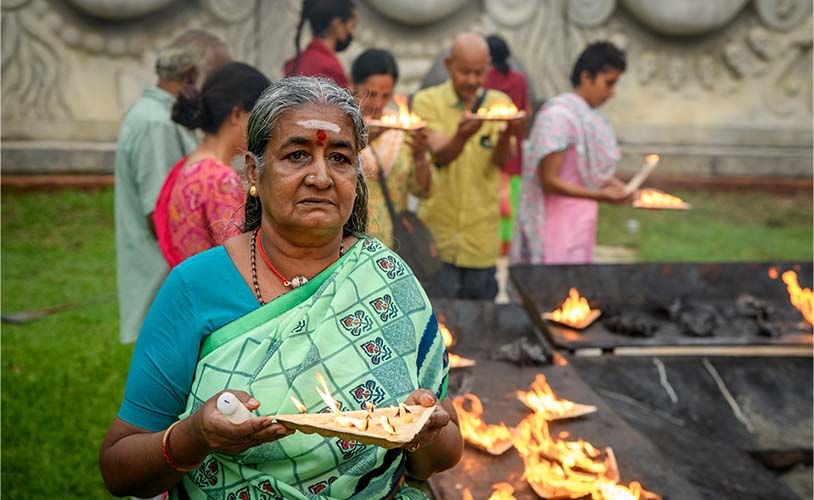
Offer ghee lamps to light up the new year with Devi's grace