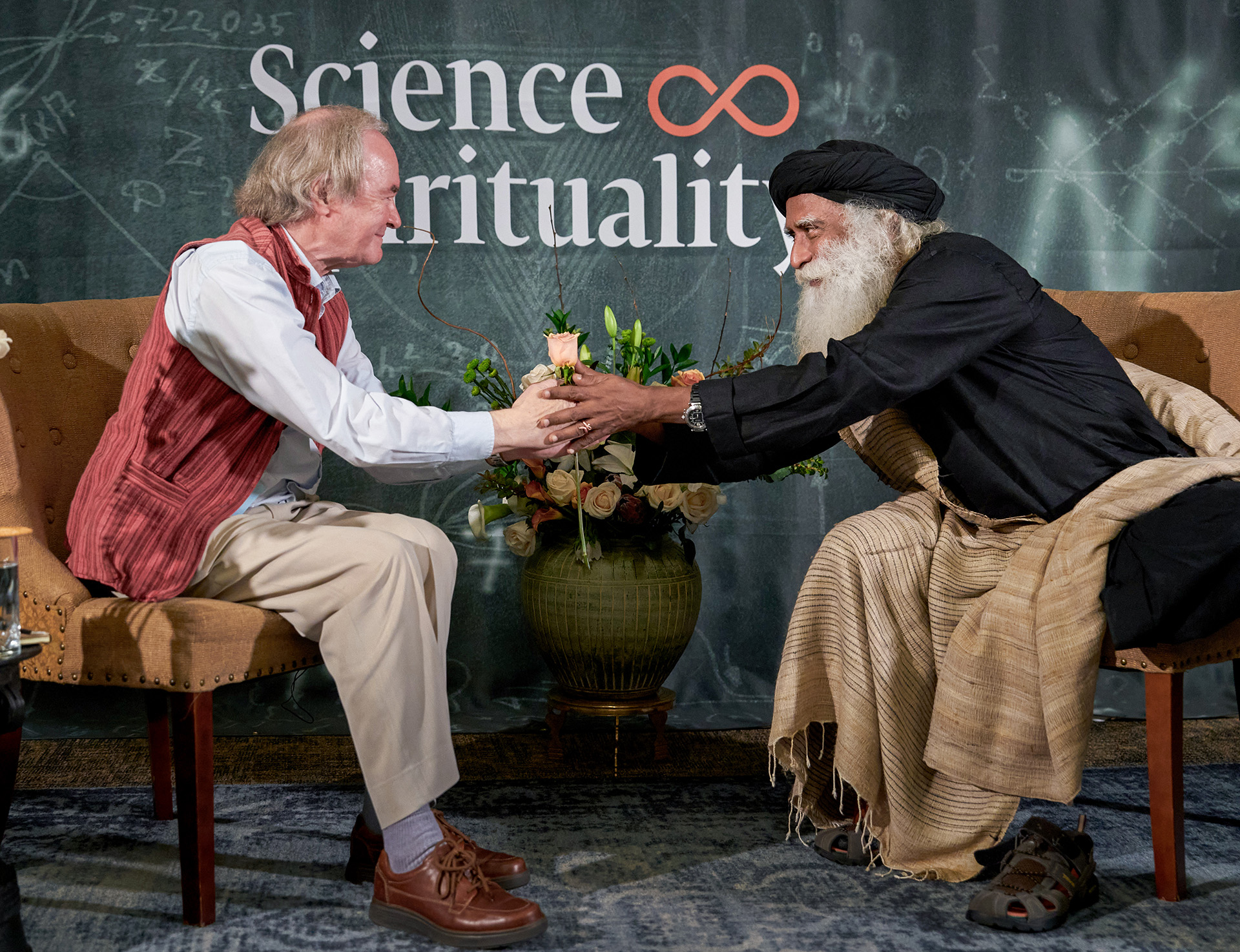
Immerse yourself in an intriguing dialogue between eminent mathematician and astronomer Prof. Bernard Carr and Sadhguru, as they navigate the intersection of science and spirituality. In this captivating excerpt from a recent panel discussion at Harvard University, Carr propounds the necessity of evolving the construct of space-time in physics to incorporate mental and spiritual phenomena. Meanwhile, Sadhguru unfolds the multi-faceted concept of consciousness from the yogic perspective. Enter an intriguing exploration of the mind, time, space, and beyond.
Prof. Bernard Carr: I think it is essential to expand physics to accommodate mental and spiritual phenomena. I’m a physicist, and I’m passionate about physics. I’ve seen how successful it has been describing the material world, and I want to expand that success to these other domains. I think that can be done by expanding one’s ideas of space and time. But I should say that everything I'm going to say now is more speculative.
Within the concepts of physics, what we mean by space has changed. In Newtonian physics, you had three dimensions of space, and you had one dimension of time. That was the idea of reality. But then Einstein came and proposed a four-dimensional reality where space and time merge together.
But then in the 1920’s, the physicists Kaluza and Klein realized that they could give a geometrical interpretation of electromagnetism by invoking a fifth dimension. Einstein had given a geometrical interpretation of gravity in terms of curved space. Then in the mid 1990’s, Ed Witten, a brilliant physicist from Princeton, realized that in fact, you need 11 dimensions.
Sadhguru: Oh, in the Yogic sciences, it’s always seen as 11 dimensions. I didn’t know a man from Princeton could say that. [Laughter] That’s very interesting. The nature of truth is such that from whichever direction you look at it, it is still the same thing.
Prof. Bernard Carr: Right, right. The idea is that in this 11-dimensional theory, the physical world is just a slice of a high dimensional space. I now want to come at the problem from the point of view of mind. Some of these theories are purely mathematical. But the people who are exploring this are physicists. I always take the view that there isn’t evidence now, but if you wait long enough, the evidence may come.
Now let’s ask about mental experience. We all know that we experience this world, phenomenal space. But that’s our experience of the physical world. And there’s a long philosophical debate about the relationship between physical space and phenomenal space, but that’s really relatively straightforward. However, I’m interested in the spaces we experience in states of consciousness other than just the waking state. There’s been a lot of discussion about dreams and lucid dreams, and then there are out-of-body experiences. In out-of-body experiences, your consciousness leaves your physical body and seems to wander around. Even though it’s related to physical space, it’s not identical to it.
Then you have the experience of ghosts, apparitions. Most psychologists would say the ghost is just a hallucination. However, there are cases of ghost sightings that are collective in the sense that more than one person sees them at the same time. And it’s as though the ghost is in a space of its own; it doesn’t exist in normal physical space; in that sense, it’s not regarded as real.
And then there are near-death experiences; they occur in a space, in the sense that you go through a tunnel where you cross a bridge; but again, it’s not physical space. Then there are mystical experiences, and some also seem to involve a space, but not physical space. So to summarize that, mental and spiritual experiences very often involve a sort of space. And if you like, a collective mind space in which our individual minds, individual consciousnesses are part of Consciousness with a big C, and individual minds are part of this Mind with a big M.
Then the question is, how do I relate this space for mind and spirit to this space which the physicists have talked about? My proposal is that I should identify this higher dimensional space of physics with this higher dimensional space required for mental and spiritual experience. The only thing that I’m aware of are my own mental experiences, so it seems to be fairly natural to put my mental and spiritual experiences in this higher dimensional space.
Dr. Balachundhar Subramaniam: Sadhguru, do we have a comment on what Bernard just said?
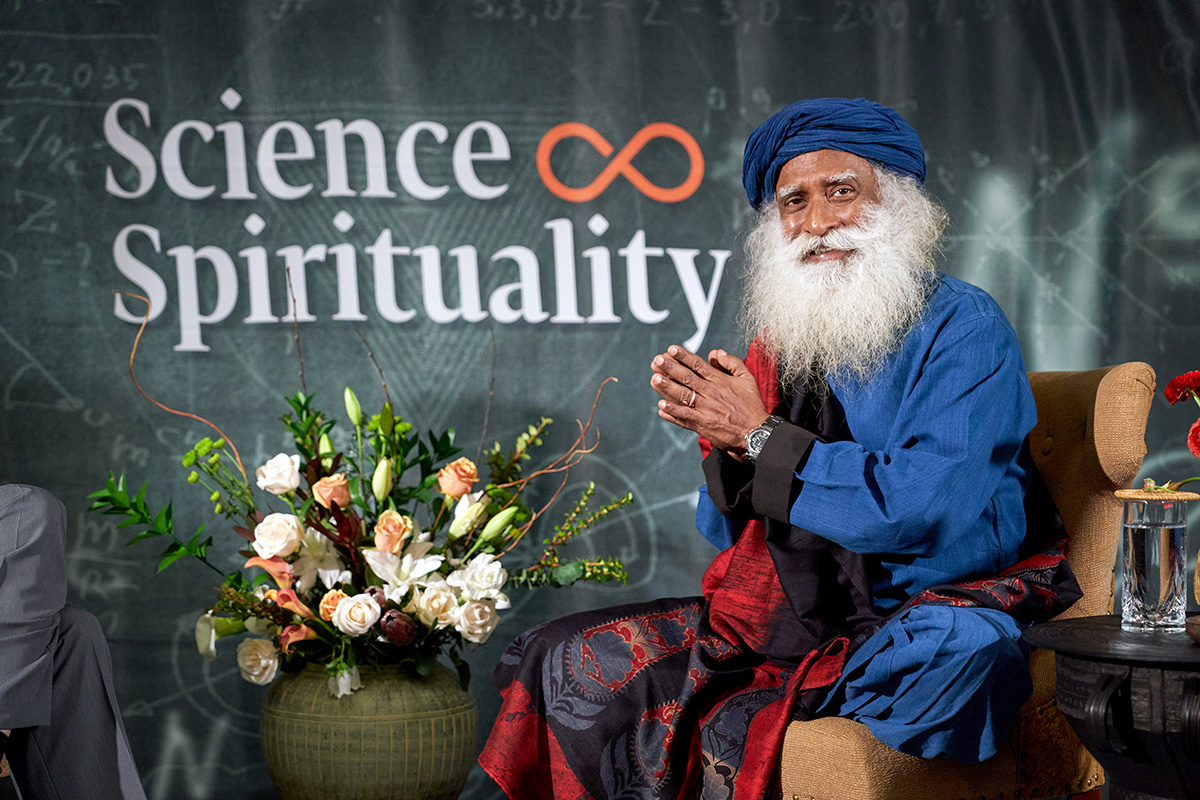
Sadhguru: In the modern understanding of the term “mind,” we often refer to it as a single entity. But in the Yogic sciences, we see the mind as having distinct aspects. The front end of the mind is the intellect, called buddhi. And there is a second aspect of the mind that we call ahankara, which is essentially identity.
The more identified you are with something, the more committed your intellect is to that identity, and it will work within that framework. If you’re identified as a scientist, a mystic, a Yogi or whatever, your mind will function within that framework. Your intellect is totally committed to your identity. If you identify yourself with a certain religion, your mind functions one way. If you see yourself as an atheist, it functions another way. If you identify with this nation, it functions one way; if you identify with something else, it functions in a different way.
This fixed identity is the basis of all human intellect functioning in different ways. There are whole systems of Yoga where we are constantly working to see that the identity is cosmic in nature, that you don’t identify with anything in particular. It is difficult to not identify with anything, so you identify with something that has no discernible boundaries.
So how to go beyond one’s identity? Is it possible? 100 percent. But if you go beyond your identity, you lose your personality completely. Are you willing to do that?
The next aspect of the mind is eight dimensions of memory. We refer to this as elemental memory, evolutionary memory, genetic memory, karmic memory, conscious and unconscious memory, and articulate and inarticulate memory.
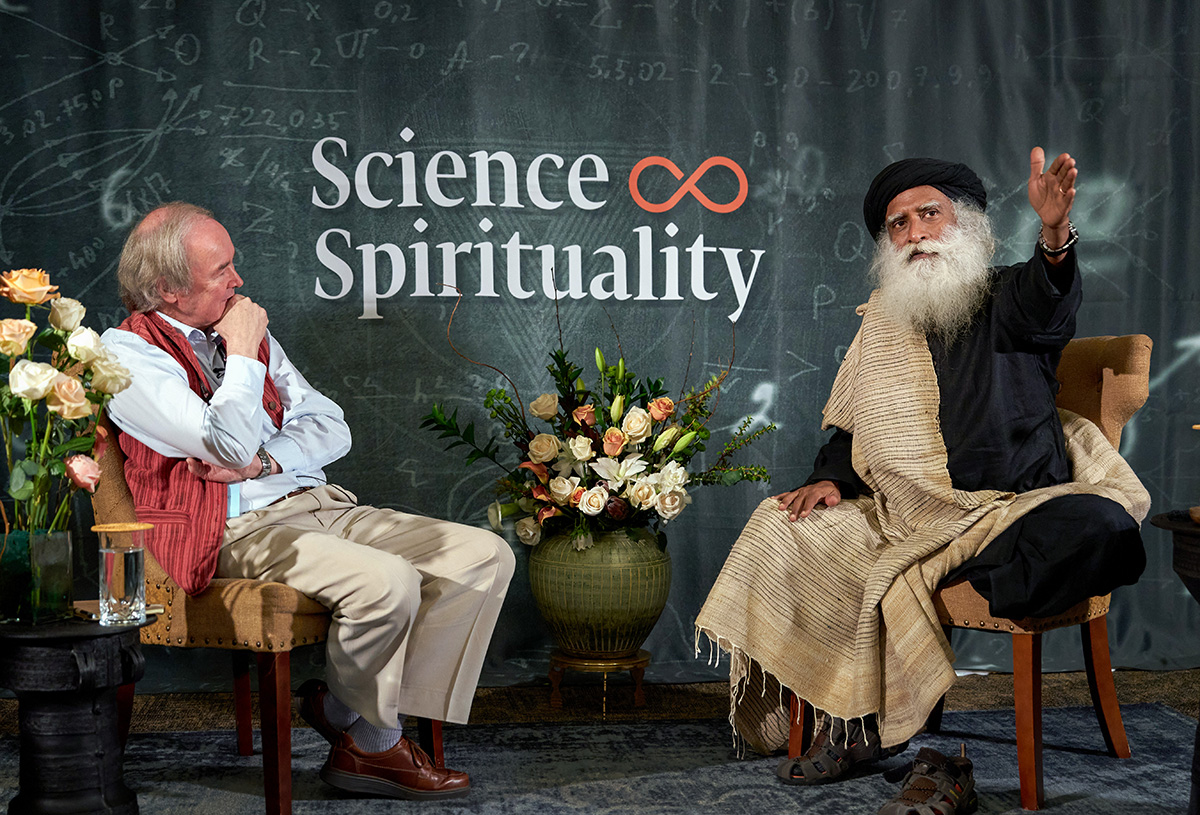
If I ask you a simple question, do you want your intellect to be sharp or blunt? Essentially, your intellect is a cutting instrument. With a cutting instrument, you can dissect. By dissecting you, I may find your liver, kidney, and spleen, but I will not find you. If I dissect you, I will know nothing of you. But if I embrace you, if I include you in some way, I will know something. We are trying to use this instrument of cutting or dissection across the board for everything. It is like using a knife to stitch your clothes with it – everything will be torn.
If you try to handle your life with just your intellect, it will be in bits and pieces. You have seen that with modern education, people are more confused than ever before. It takes a lot of striving to ensure that you are not influenced by any data that comes to you. You are not influenced by any information that you carry, no matter how valuable or sacred it is, or where it comes from. Whether it comes from a scripture, a professor, or a Guru – you are not identified with that. Similarly, there is a whole lot of data in you from parentage, from circumstances, in so many different ways, but you remain uninfluenced.
So, what kind of hand holds the knife will decide how it is used – will it save or will it take someone’s life? It is not dependent on the knife but the hand which holds it.
And now this hand is connected to a silo of memory. If your identity is limited, it will use all these memory capabilities in a limited way. Essentially, the intellect is an instrument of self-preservation. You need preservation on physical, emotional, social, and various other levels to live. Self-preservation means survival. Survival is very important, but at the same time, it doesn’t ever fulfill you.
If you had come here as any other creature, stomach full, your life is settled. Once you come as a human being, stomach empty, only one problem; stomach full, 100 problems. This is the nature of a human being. What you call as human begins only after your survival is taken care of. Till then, you are just another biological creature. Only when survival is settled, and your instinct of survival is kept down, does the possibility of being a conscious human being arise within you.
Keeping your identity down or making it as limitless as possible in your imagination is most important to see that the knowledge, memory, or information that you have from various sources, functions in a way that is not in conflict with yourself or with anything else. Right now, the information you carry tortures you in a thousand different ways, because if you have a very sharp knife, you must have a very steady hand.
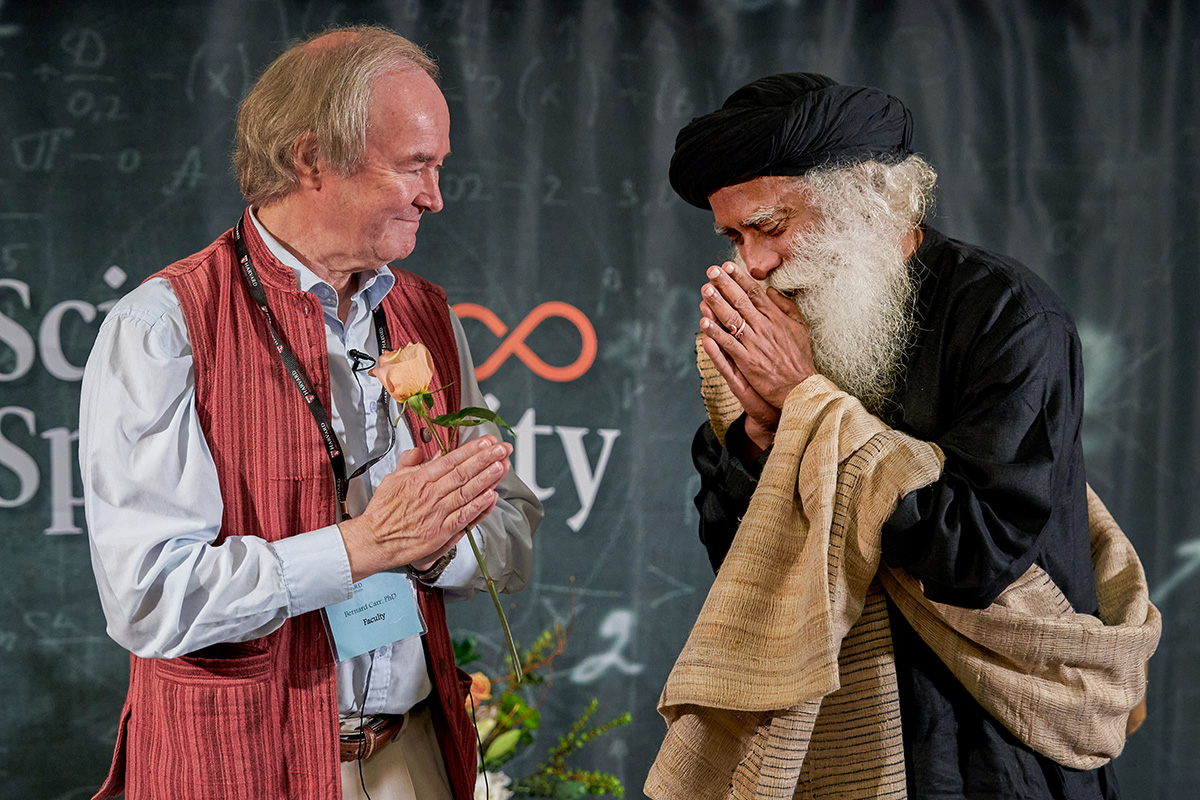
The third part of the mind is called manas, which is a silo of memory. Chitta, the fourth portion of the mind, is the most important one but remains largely unexplored by people who approach life in an intellectual way. Chitta is an intelligence that is unsullied by memory. There is no memory, but it is intelligence. Only if you give it a little bit of memory, will it function according to the intent and direction of that memory. Otherwise it is not active, but it is the basis of everything.
Right now, the word consciousness is everywhere. Being conscious or unconscious are two different states, but consciousness is not about this. We are essentially misunderstanding mental awareness as consciousness. Let’s look at it from the other side. There’s prana, pragna, and chitta. Pragna is your awareness. Right now, you are in pragna; you are aware, not asleep.
Prana is the intelligence within you that allows your heart, liver, and every other organ in the body to function. There is an intelligence within you that is doing all this. You can never figure it completely, because the intellect functions from the limited data that you have fed it.
Even modern physicists are saying that existence is boundless. By trying to intellectually define what is boundless, we have been barking up the wrong tree for too long. It is fortunate to see that at last, science is pointing in the right direction. It is time to get the eyes to see it. That is a different task altogether.