SOIL & SUSTENANCE
Sadhguru and Actor Ian Somerhalder on the Hidden Crisis Beneath Our Feet
In a very real sense, you are soil. Every cell in your body was assembled from food grown in the ground. As Sadhguru puts it: “The body that I carry is the soil that I walk upon. They’re not two different things.” And that soil is in serious trouble.
In a pointed conversation with Hollywood actor and environmental advocate Ian Somerhalder on 26 April 2026, Sadhguru made the case that soil – not climate, not water, not energy – may be humanity’s most urgent and most overlooked crisis.

The soil beneath us is alive
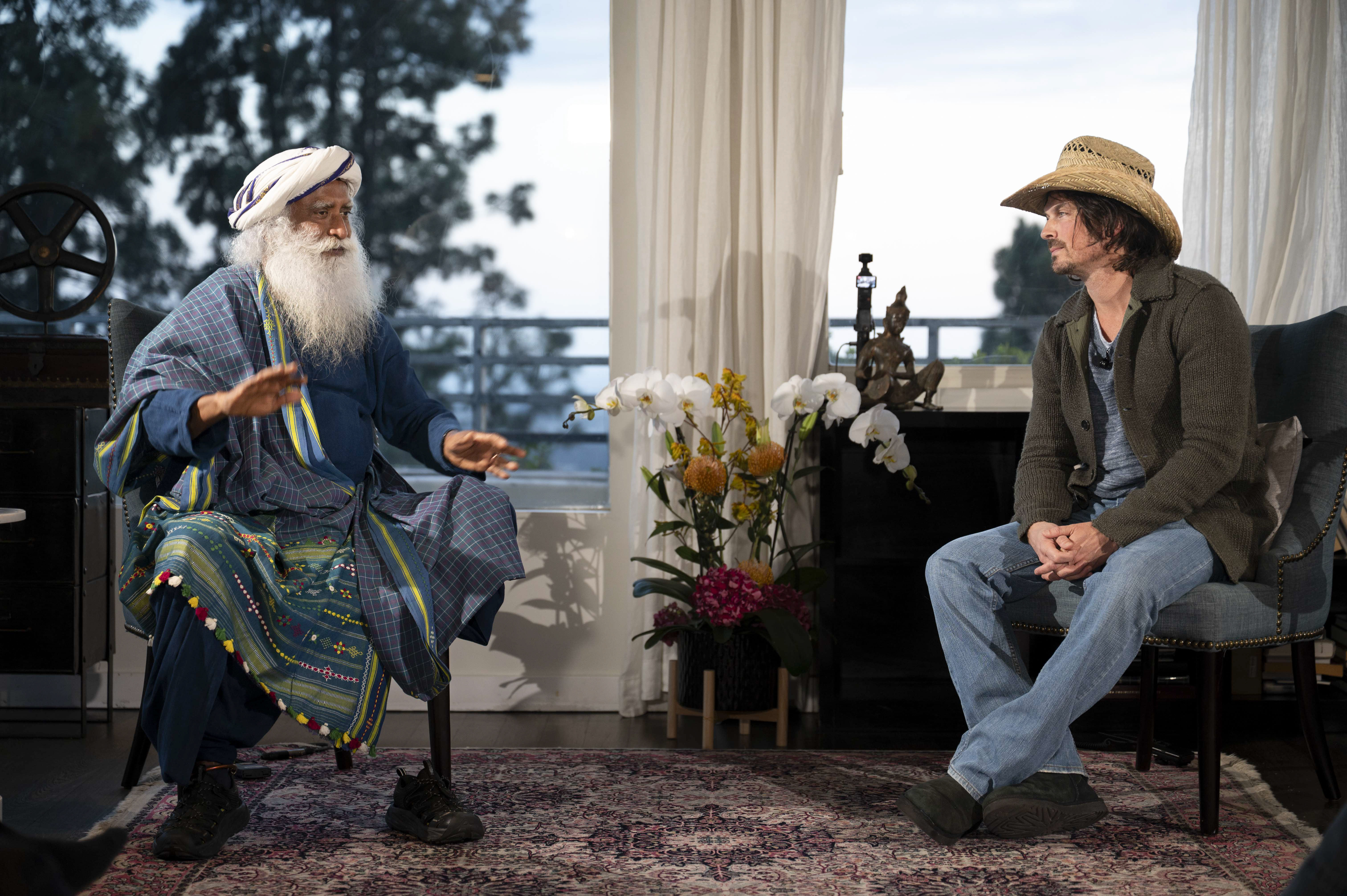
Most people think of soil as inert, lifeless dirt. That assumption, Sadhguru says, may be one of the most dangerous misconceptions of our time. “Soil is not some inanimate stuff,” he says. “Soil is the largest living system – not just on the planet – in the known universe.”
A single handful of healthy soil contains over six to eight billion organisms – a number that rivals the entire human population of the planet. Somerhalder paused on that point during the conversation: “There’s as many organisms in that handful of soil as people living on the planet. Let that sink in for a second.”
And yet even agro-scientists, Sadhguru says, “don’t think of soil as a living system. It’s a very, very dangerous way of looking at life.”
What we’ve lost without noticing
When the conversation turned to nutrition, Somerhalder raised a figure that already seemed alarming – a 60 percent loss in both topsoil and nutrient value in food. Sadhguru corrected him without hesitation. The real number, he said, was closer to 90 percent. Somerhalder absorbed that before drawing the obvious conclusion: as you degrade soil, you degrade the food that grows in it.
Sadhguru points to stark figures: most vegetables commonly consumed in America – lettuce, tomatoes, and others – have seen an 80 to 90 percent reduction in micronutrients. In India, beans have lost over 62 percent of their protein value in just the last 20 years.
“One of the significant aspects for the kind of mental destabilization that you’re seeing today is lack of micronutrients in the food that you consume,” Sadhguru says. “Your stomach is full, but it doesn’t have enough.”
Dr. Emeran Mayer, a microbiome expert who joined the conversation, explained what happens at the root level: “The nutrients that you’ve talked about are very much dependent on how the microbes interact with the root system of the plants, and stimulate them to produce these health-promoting micronutrients.
“If you take away that system and use chemical agriculture, the plants look great, but when you eat them, you won’t get any of these beneficial micronutrients.”
Somerhalder drew the connection plainly: “The human body is effectively only as healthy as the microbiome of the gut, right? Soil is only as healthy as the microbiome of soil. It’s the same biological process.”
The people who feed us are disappearing
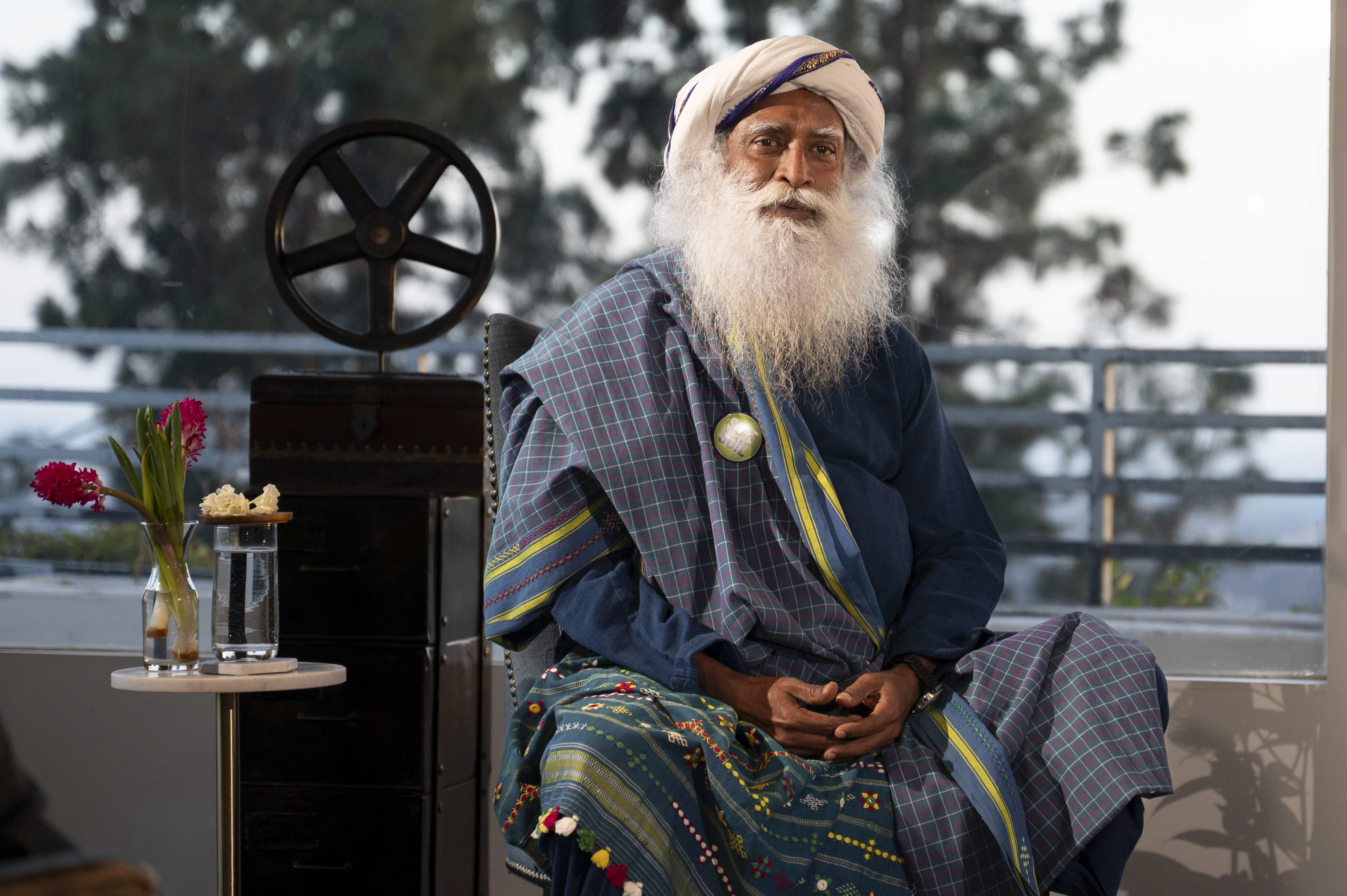
“The most deprived profession on the planet is farming – who feeds all of us,” Sadhguru says. “Over 50% of all US farmers make a net loss because input costs are going up like that.
“And if the produce is raised accordingly, in every country the inflation will go five, ten times more than what it is right now. So we have decided to kill the farmer and think somehow it will work. In every country, this is almost without exception.”
Sadhguru sees this as a civilizational warning sign. In another 25 years, he says, when the knowledge of how to transform mud into food disappears, “it’s not a small thing. It takes a different kind of intrinsic relationship with the land to make that happen. So, that generation if it moves away, it’s almost like an end game.”
A chain reaction already underway
In the past few decades, there has been a more than 70 percent decline in insect populations. Seventy-three percent of the vertebrate populations are gone. Eighty-three percent of freshwater species are gone.
Where the Mississippi enters the Gulf of Mexico, over a thousand square miles of water is now nearly biologically dead – with very little marine life – because of fertilizer and pesticide runoff carried downriver. Somerhalder noted quietly that the Mississippi River Delta is where he grew up.
Remove the organic matter from soil, and it becomes sand. Replenish it, and sand can become soil again.
In parts of Africa, soil organic content has fallen to just 0.3 percent in severely degraded soils – the lowest in the world – and the desert has expanded by 10 to 12 percent in just 20 years. Southern Romania’s agricultural land is increasingly being overtaken by sand. So are parts of Azerbaijan’s lowlands.
As Sadhguru explains it: every time you harvest crops, you remove nutrients and organic material from the land. Without replenishment, that soil has a finite lifespan. On average, between 25 and 40 years of farming is all that degraded soil can sustain. After that it becomes a desert. Nearly two-thirds of the world’s agricultural land is estimated to reach that point by 2050.
When soil can no longer grow food, people move. By 2035, between 1.4 and 1.6 billion people are projected to migrate globally because growing food in their native lands is becoming impossible. Africa alone could contribute over one billion people to that movement. “Any unplanned migration of people is torture,” Sadhguru says.
Somerhalder was direct about who bears the greatest cost: “What happens there is most inhuman, most inhuman, particularly for women and children. This is happening because they are not able to grow any food in their lands.”
What can actually be done
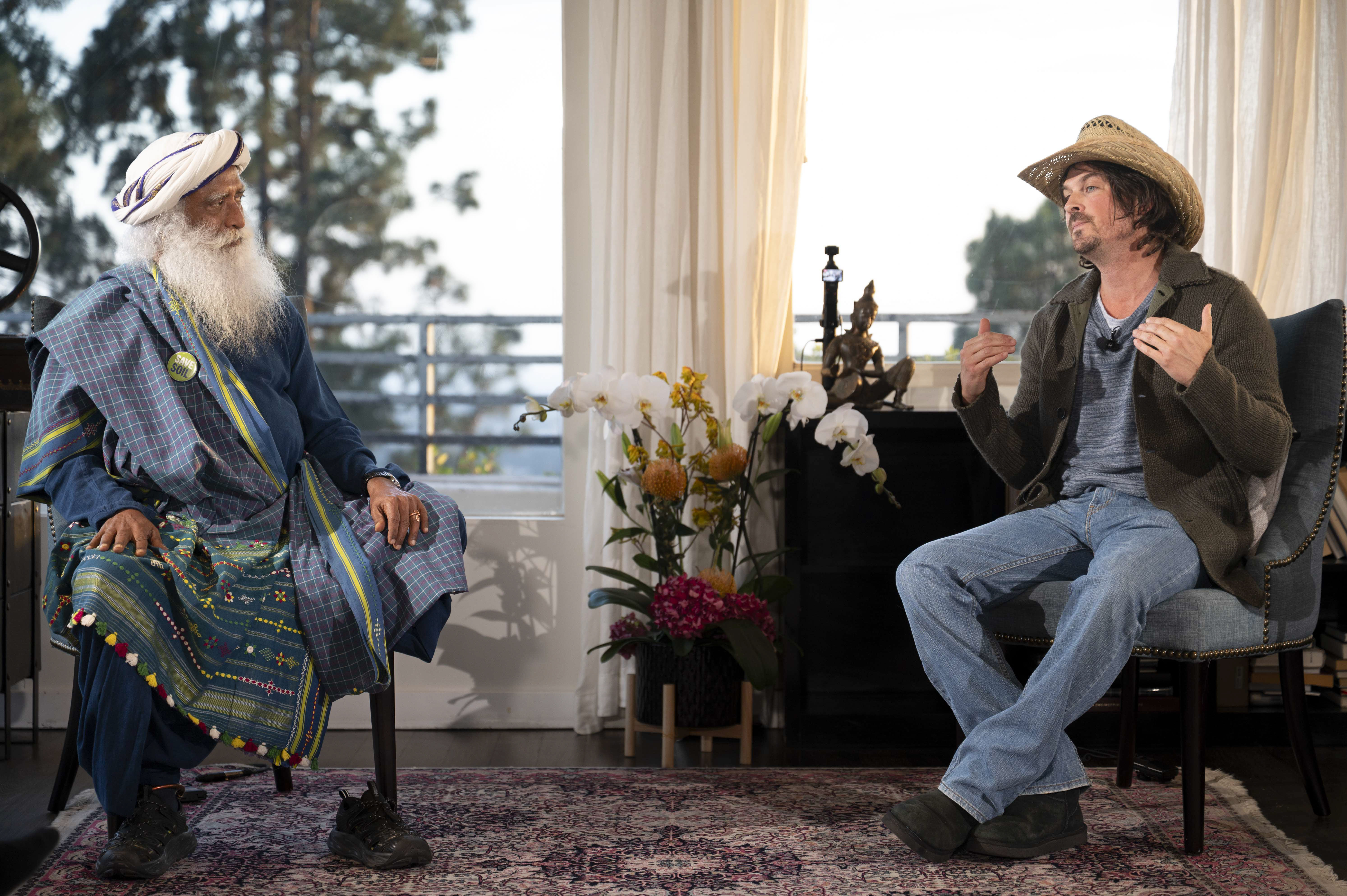
Somerhalder pointed to regenerative agriculture as an immediate opportunity: “We have a moment in time right now where we can actually deploy these regenerative systems, which is the exact thing that saves soil.” When farmers reduce tillage and eliminate chemical inputs, he noted, they start saving significant money – and the soil begins to recover.
Sadhguru’s approach has been rooted in policy change. “Where is the guarantee that the next generation won’t rip it out? This is why a policy is very important.”
His most concrete example is the Cauvery Calling movement in India. The Cauvery River, which once flowed abundantly through three states, today runs at only 40 percent of its former volume. To restore it, Sadhguru set out to plant 2.42 billion trees across the river’s basin.
But there was a legal obstacle. In many Indian states, a farmer who cut a tree grown on their own agricultural land could be arrested. After more than a decade of advocacy, those laws were changed. Farmers could now grow timber alongside their regular crops. Farmer incomes went up by 300 to 800 percent. Water tables rose significantly across the region.
Somerhalder saw the global implication clearly: “Tree-based agriculture is going to most likely shift Africa. These are monumental movements. It’s happening right now as we speak.”
We are the soil we’ve forgotten
“The reason why we are handling the planet the way we are handling it is that we are not even in touch with the life that we are,” Sadhguru says. “Our idea of life is right now only of our physiological needs, and our psychological circus.”
“One of the biggest misconceptions of humanity is that we are separate from our environment,” Somerhalder said.
Sadhguru calls the modern condition “high heel life” – in every way, he says, we are looking for how to be away from the soil. And in that distance, we lose sight of what we actually are. “These two accumulations of body and mind, your accumulations, you must use. What belongs to you, you must use it well. But you cannot claim it’s me. The moment you make this mistake, everything that you do is a mistake.”
“In this seemingly limitless cosmos, planet Earth is a speck. In that speck, Los Angeles is a micro-speck. In that micro-speck, you are a big man. Before you and me came here, countless people have walked this place. Where are they? All of them topsoil. You will also be topsoil, unless your friends choose to bury you real deep.”
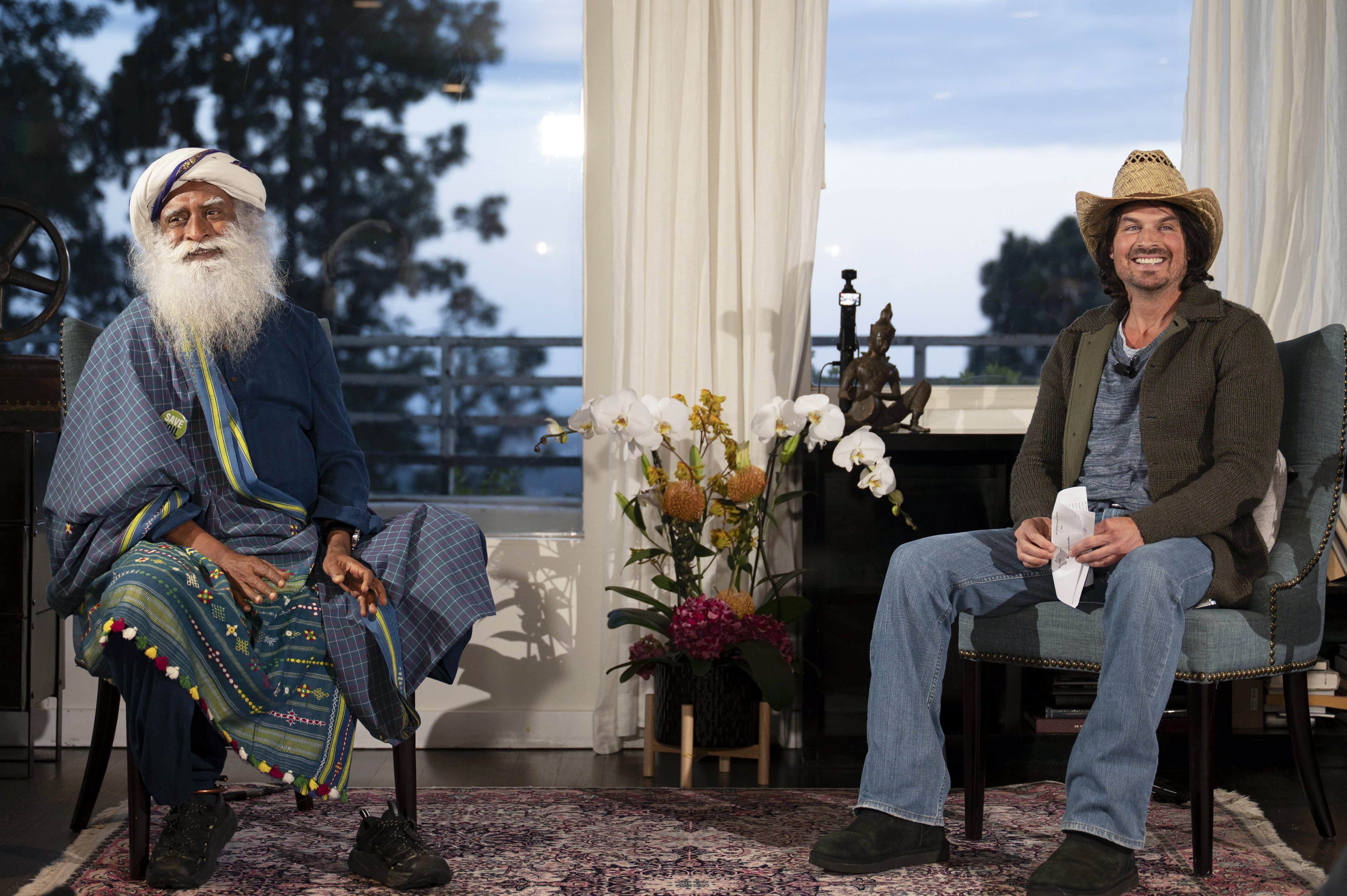
When the conversation drew to a close, Sadhguru said the real takeaway is no takeaway. Somerhalder echoed it immediately. “Because the planet won’t allow you to take away anything,” Sadhguru said. “Because you didn’t bring anything.”